Concert Review: Piano And Flute Recital/ Tedeschi And Walker

Recital of music for piano and flute

Simon Tedeschi and Sally Walker

Hunters Hill Music

Hunters Hill Town Hall

13 June, 2021

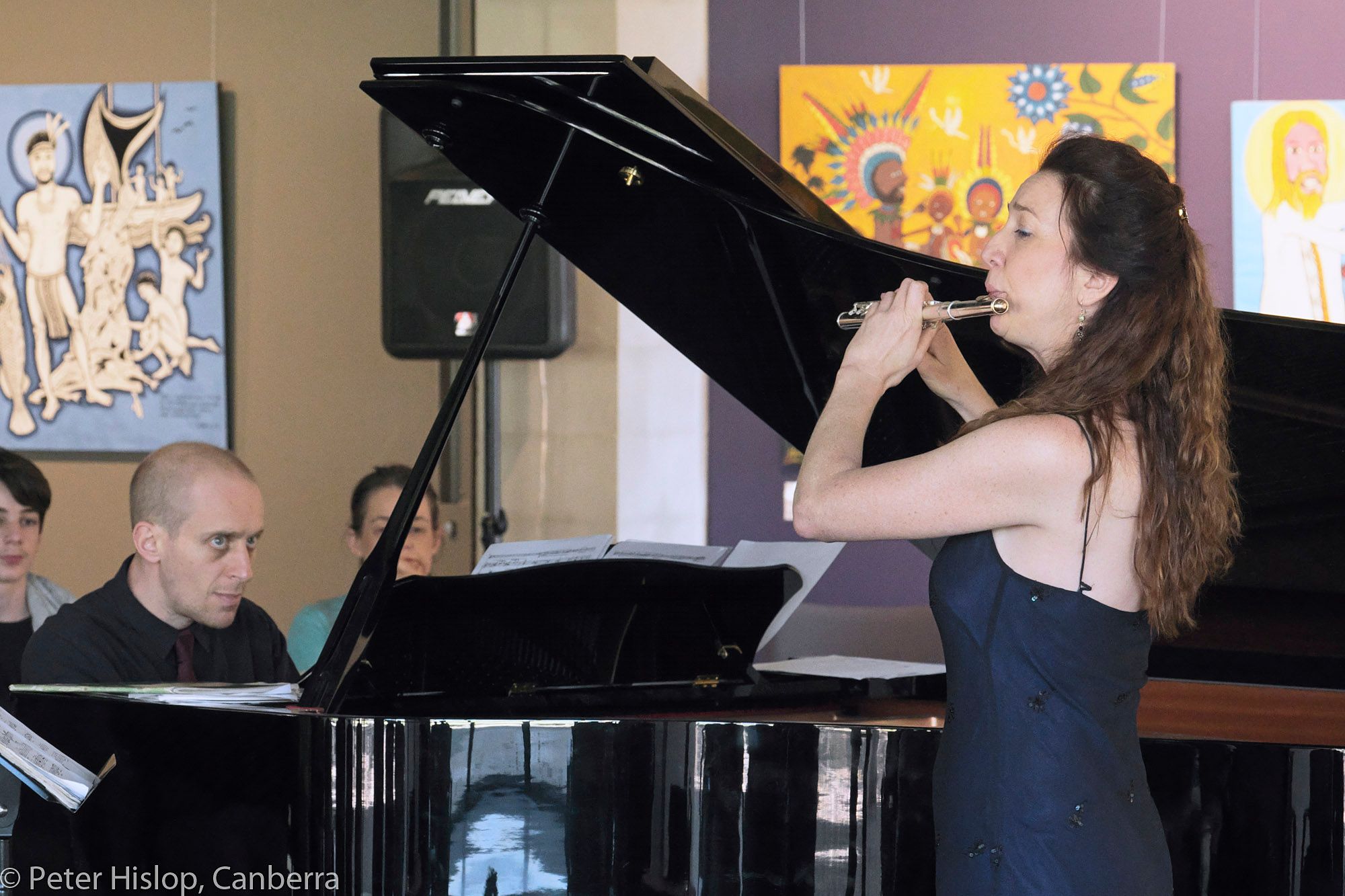
Flautist extraordinaire Sally Walker teamed up with acclaimed award-winning pianist Simon Tedeschi for a soirée presented by Hunters Hill Music in a program built around the concept of miniatures. As Walker explained in her dialogue with the audience, this was an “uplifting pandemic program which aimed to freeze a small moment of happiness.”

The miniatures came from all around the world but setting the template were French pieces by Gabriel Fauré and Erik Satie – Fauré’s Fantaisie op. 79, used as an examination piece by the Conservatoire de Paris in 1898, 1916 and 1925, and the exquisite Sicilienne, Op. 78, composed in 1893 and originally an unperformed orchestral piece. The Sicilienne was later arranged by Fauré for cello and piano in 1898. Satie’s Gymnopédies 1 and 3 followed, with Tedeschi lengthening the tempo of the No. 1 in a piano solo followed by a duo version of the No. 3 – the flute perfectly encapsulating the elegance and lucence of this late 19th century style.

The French flair continued into the 20th century with Philippe Gaubert’s Madrigal. A distinguished flautist, conductor and composer whose appointments included Professor of flute at the Paris Conservatoire and principal conductor of the Paris Opéra. Walker and Tedeschi revelled in his exemplary writing for flute and piano.

A composer writing for the instrument at which they are adept is as special as a piece written especially for a performer. Walker and Tedeschi tossed French restraint aside in the passionate teasing of Milonga del Serafin which was written especially for Sally Walker in 2001 by Argentinian composer Coco Nelegatti. Gershwin’s Rhapsody in Blue is another piece which has become synonymous with its performer and Tedeschi’s arrangement for piano was warmly received.

Combining a busy schedule of teaching and performing, mainly in Sydney, Newcastle and Canberra, Sally Walker has done much to champion the flute and its repertoire – established and new. The second half of the program contained pieces composed for the flute and included the Entr’acte to Act III from Bizet’s Carmen, Elena Kats-Chernin’s Chatterbox Rag commissioned by Walker for a “cheeky” 16-year-old student of hers, aptly played on the piccolo and in a return to the French genre, two pieces by Poulenc, one discovered in 2000 Un Joueur de flute berce les ruines and the popular Sonata for Flute and Piano.   

In this mix were pieces written for piano and violin but transcribed for flute. A Romanze by Max Reger, for piano and “violin (or flute),” Amy Beach’s Romance (piano and violin) and Arvo Pärt’s Spiegel im Spiegel, the tintinnabular duet written for piano and violin, but adapted for many other combinations. The pairing of a tinkling piano, requiring a vastly different touch to Gershwin’s jazzy chords and pounding rhythms with the dusky alto flute in a transcription made by the composer, where the melody sings over diatonic scales, was a truly mesmerising experience.

There was a gracious return for an encore – Percy Grainger’s arrangement of Londonderry Air, bringing the soirée to a close. Interspersed with vignettes about their own musical journeys and their longstanding collaboration, Walker and Tedeschi performed on instruments so different in timbre and sound production but which contrast and complement each other so well in their hands. Simon Tedeschi proved himself to be as skilful an ensemble player as he is a soloist and Sally Walker is, I believe, Australia’s best flautist.

Shamistha de Soysa for SoundsLikeSydney©

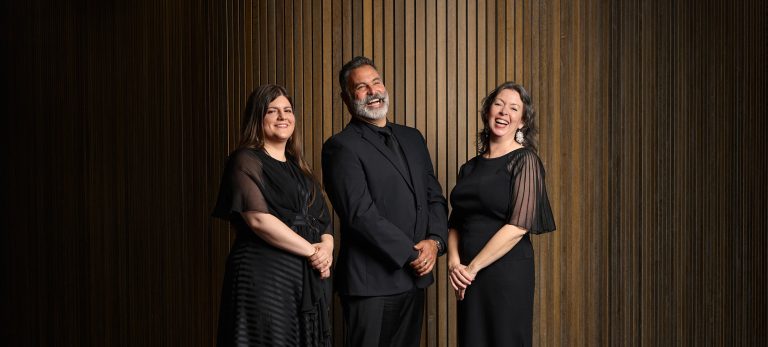
Image Peter Hislop
Similar Posts

  • Concert Review: Splendour And Mystery/Sydney Chamber Choir

    Splendour and Mystery/ Sydney Chamber Choir
    Verbrugghen Hall, Sydney Conservatorium of Music
    Australian Digital Concert Hall
    25 March, 2023
    In Splendour and Mystery, Sydney Chamber Choir under the direction of Sam Allchurch joined forces with Camerata Antica led by Matthew Manchester and organist Thomas Wilson in an adventurous anthology of music written for double choir. Specialising in the music of the 16th and 17th centuries, the founder of Camerata Antica, Matthew Manchester playing the fiendishly difficult cornetto, was joined by Michael Wyborn, William Kinmont and Paolo Franks playing the equally challenging alto, tenor and bass sackbutts respectively.
    Bookended with pieces by Giovanni Gabrieli with one of his refreshing Canzonas in the middle, the program also contained music by living Australasian composers Clare Maclean and Brooke Shelley, Gabrieli’s contemporary and student Heinrich Schütz and 20th century composers John Tavener and Frank Martin. Together these composers explore and exploit the potential of the double choir with its opportunities for super-rich harmonies, added melodic lines, imitation, choral interplay and variations in the positioning of the singers.
    The opening motet, Gabrieli’s Jubilate Deo omnis terra, C 65 was quite literally a musical shout for joy. A major part of this journey back in time to Renaissance Venice was the unique sound of Camerata Antica. Heralded by the instruments, the 10 lines of the choir sang an uplifting, lively and tightly dotted chorus, alternating with homophonic passages. Allchurch and his ensemble clearly delineated the rhythms, changing time signatures, hemiolas and other displaced accents which created the buoyancy of this celebratory piece.
    John Tavener’s brilliant A Hymn to the Mother of God transcends the mortal and looks to the cosmic powers of Mother Mary. Writing in the style of canon, with imitative lines that start in quick succession and not necessarily in harmony, Tavener creates a sense of ‘other-worldliness’ in this simple but awe-inducing piece in three-sections. It was a slow burn as the two choirs sang with shimmering lightness and a sense of spinning through space, creating vivid colours and  clusters of clashing chords with impressive control as the voices rose in range and dynamic to its full-bodied climax.
    The program moved imperceptibly to the German Magnificat by Heinrich Schütz, as the choirs were joined by organ and instruments. This was a relevant and important inclusion as Gabrieli himself taught Schütz in this multi-choral technique which Schütz then developed in his own style.
    Clare Maclean’s moving Christ the King was sublimely sung, opening in the manner of a plainchant by the female voices which peeled off into mirroring phrases by the other voices, ending in a reprise of the plainchant. Premiered by this choir in 1984, it is precisely opportunities like these which new composers need for their music to be heard and re-heard until it becomes recognizable to listeners and enters the DNA of the concert repertoire.
    The short and brilliant burst of Gabrieli’s Canzona seconda, C 187  from Camerata Antica showcased these rudimentary instruments in all their imperfect glory as the choir positioned itself for Frank’s only unaccompanied choral work, the demanding  Mass for double choir, considered to be one of the finest and most complex pieces of 20th century choral music. The choir did ample justice to this piece which incorporates the aesthetics of Renaissance music, French Impressionism, Schoenberg’s twelve-note system and J S Bach. The altos began the Kyrie with a freely-flowing, supplicating melody; the Gloria built step-wise to cluster chords; the Credo was a business-like affirmation of faith; the canon-styled Et Resurrexit was levity, hope and word-painting to perfection; the Sanctus introduced softer harmonies from the male voices. The mass, Version 1, ended with a powerful Benedictus. Fast forward to 1926 and Martin added the Agnus Dei, the crowning glory to this choral magnum opus. The mass culminated in a glorious unification of the choirs.
    Brooke Shelley’s Heavenly Father, composed in 2022, performed in the presence of the composer was premiered in November 2022, by the Sydney Chamber Choir. A lyrical and beautifully textured piece, it is very pleasing that it has quickly been programmed again. Like the slightly older piece by Maclean, it is critical that new pieces of merit such as these, are given regular and frequent hearings so that they may be heard widely and face the test of time.
    Finally, Gabrieli’s Magnificat a 14, C 79 brought together the full instrumental and vocal forces of the ensemble. Using the 16th century Venetian technique of cori spezzati (split choirs), the brighter sound of the female voices and cornetto took to the left gallery with the male voices and the thrilling grunt of the bass and other sackbutts in the right gallery with a mixed ensemble placed and organ placed centrally on stage.
    This was an intelligent and audacious program from Allchurch, performed with glorious sound by a choir secure in technique, pitch and musicianship.

  • ‘Operamania’ reviewed.

    Operamania is an opportunity to hear an ensemble of Russian classical performers, doing what they do best. The ensemble of 44 orchestral musicians, conducted by Andrei Lebdev, 10 singers,  4 dancers and a pianist from the Novaya Opera of Moscow presented an evening of Classical and Romantic favourites from opera, ballet and symphonic works. Projected behind them…

  • Album Review: Omega Ensemble: Mozart/ Munro/ Palmer

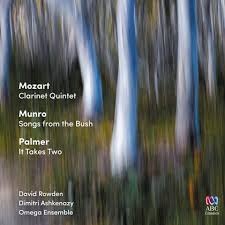
    The Sydney based Omega Ensemble has come of age with its debut album Mozart-Munro-Palmer (ABC Classics 481 4667) that gathers a triptych of works for clarinet and chamber ensemble. The album features Artistic Director David Rowden, who founded the ensemble in 2005, as the clarinet soloist anchoring the tracks with the matchless Clarinet Quintet in…

  • CD Review: Handel’s ‘Messiah’/Minkowski/Deutsches Grammophon Virtuoso

      Handel Messiah/Marc  Minkowksi/Deutsches Grammophon Virtuoso. Nearly three centuries after Handel’s Messiah was  first performed in 1742, and nearly a century after its first recordings in the 1920s, Deutsche Grammophon has re-released a 2001 Archiv recording conducted by Marc Minkowski on its Virtuoso label  (Catalogue Number 478 6175). Virtuoso promises quality performances at an affordable price….

One Comment

Leave a Reply

Your email address will not be published. Required fields are marked *