Concert Review: Mozart Requiem: 100 Voices/ Australian Brandenburg Orchestra

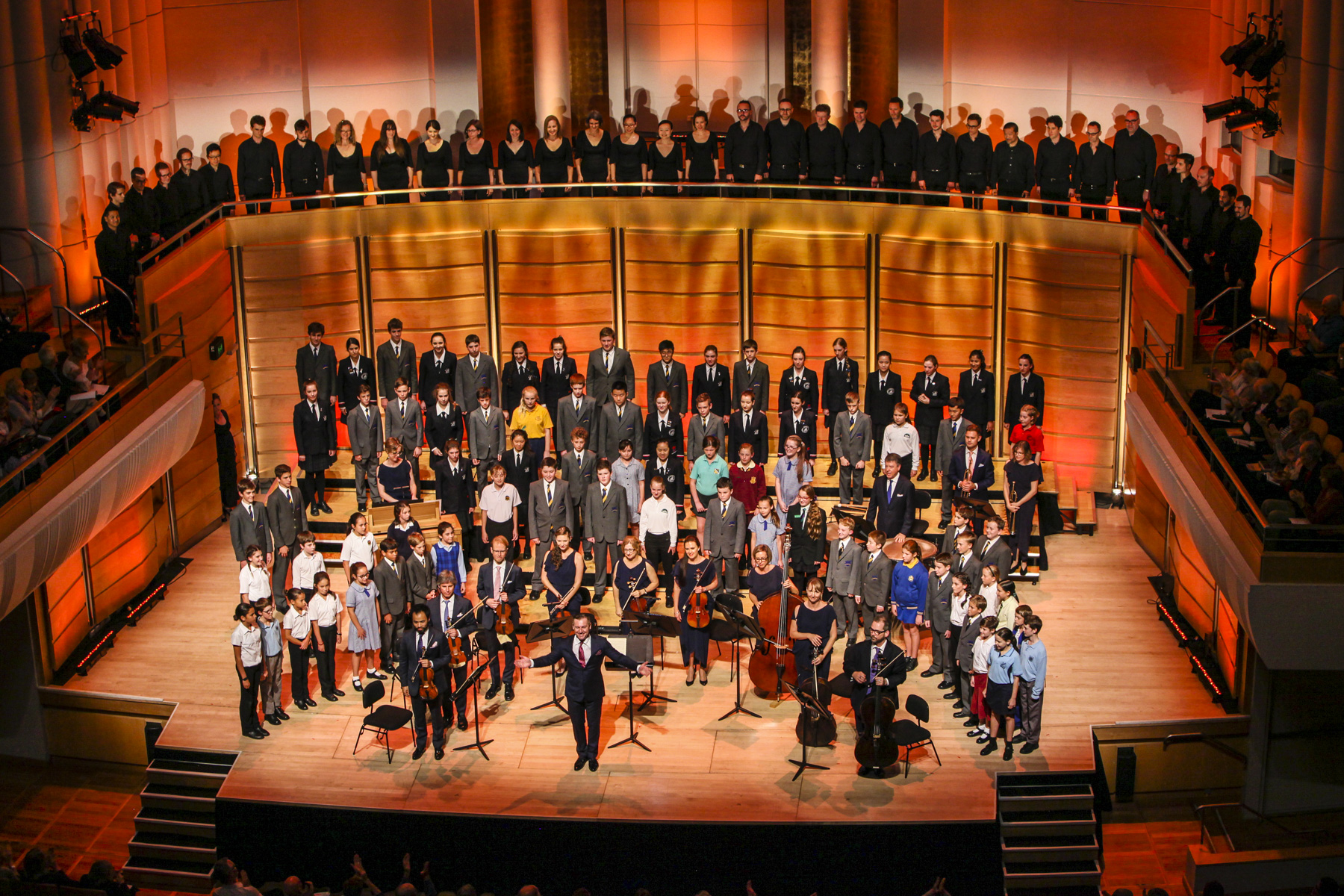
Mozart Requiem:100 Voices. The Australian Brandenburg Young Voices, Choir and Orchestra with conductor Paul Dyer
Mozart Requiem:100 Voices. The Australian Brandenburg Young Voices, Choir and Orchestra with conductor Paul Dyer. Image Steven Godbee.

There is a delicious irony to an orchestral concert that begins with unaccompanied choral items. Indeed the Australian Brandenburg Orchestra’s Mozart Requiem: 100 Voices programme was well on its way before we saw the first instruments on stage.

It was a night when voices took centre-stage, and those voices comprised school students culled from some 10 schools in and around Sydney, who made up the Australian  Brandenburg Young Voices, joined by the 34-strong Australian Brandenburg Choir.

Led by guest conductor and soprano Anna Sandström, the girls and young women of the Young Voices approached the stage down the two aisles of the City Recital Hall, singing Lyn Williams’ blithesome Festive Alleluia with echoing antiphonal effect. The boys and young men of the Young Voices followed with their rendition of the Guadete from Piae Cantiones, an anonymous collection of medieval Swedish songs. The entire youth choir sang another ancient madrigal, the Salva nos, stella maris.

Intimate as it is, Sydney’s City Recital Hall offers its performers a dizzyingly high gallery which was the platform for the evening’s four soloists, soprano Amy Moore, counter-tenor Maximilian Riebl, tenor Paul Sutton and bass Alexander Knight in a crisp and witty a capella delivery of the satirical cameo Matona Mia Cara by di Lasso, a todesca (a 16th-century polyphonic song that lampoons Germans attempting to speak Italian). The elevation created a delightful resonance and the voices were beautifully blended as the sound percolated down to the audience.

The Australian Brandenburg Choir in fine form, with its distinctive alto section composed entirely of counter-tenors gave a richly textured version of Palestrina’s Alma Redemptoris Mater, conducted by Paul Dyer.

Fast forward to the 20th century for two popular anthems by Rutter – What Sweeter Music and For the Beauty of the Earth before all the voices combined with around a dozen instruments for the incomparable Hallelujah Chorus from Handel’s Messiah.

The Brandenburg Young Voices were impeccably trained and, judging by their glowing faces, they relished the experience. They impressed with their performance of complex part songs from memory, unerring pitch, beauty of tone and discipline.

The Young Voices despatched to bed, the Brandenburg Choir and Orchestra gathered for an awe- inspiring performance of Mozart’s Requiem K 626 with Paul Dyer conducting. From the opening bars it was evident that this was going to be a performance with a difference. Dyer set a brisk pace and he had rethought the phrasing. The Kyrie was an expression of outrage at being cheated of life, as much as a plea for mercy. This arguably diminished the impact of the more apocalyptic Dies irae and blurred some of the articulation, but the pace relaxed with the Tuba mirum and the choir trumpeted the Rex tremendae with impressive majesty. The Confutatis incorporated a dramatic contrast between the incendiary lower parts and the incredible lightness of the upper parts, followed by a throbbing, sobbing Lacrimosa. As the Requiem approached its final movements the tempo became more measured, reflecting acquiescence to the inevitable – that fate, softened by the promise of redemption in the luminous clarity of the Lux aeterna.

Each of the four soloists, was exceptional; their voices well matched to the music and to each other, soaring in the interplay of the Recordare and a glorious Benedictus.

Oh – and the orchestra? Fabulous!

Shamistha de Soysa for SoundsLikeSydney©

Mozart Requiem:100 Voices continues at the City Recital Hall on selected dates until May 11.


Similar Posts

  • Concert Review: Australia Quartet ‘Transfigured Night’

      Australia Quartet Transfigured Night, Thursday 31 October, Utzon Room Sydney Opera House. Programme: Kats-Chernin E: Scherzino (2013) World Premiere. Schoenberg A: Verklärte Nacht (Transfigured Night) arr. Barton Staggs, Schumann R: Piano Quartet in E flat major, op.47. In a well balanced programme of old elements and new, the Australia Quartet’s offerings proceeded in reverse…

  • Concert review: ‘Love and Lamentations’ Sophia Mitchell Farewell

       Love and Lamentations Sophia Mitchell’s Farewell Concert Ferguson Hall, St Stephen’s church Macquarie Street 24 May 2014  Mezzo-soprano Sophia Mitchell is following the well-trodden path of promising young Australian singers and in September she and her family, including a young child, will be re-locating to London.  Having already obtained her first degree at the…

  • The Sydney Premiere of Adamo’s Little Women At The Con

    Mark Adamo’s operatic adaptation of Louis May Alcott’s much-loved classic tale, Little Women, premieres in Sydney this October at the University of Sydney’s Conservatorium of Music.  Several cast members graduate from the Conservatorium at the end of this year and the Sydney premiere of Little Women offers to be a launching pad for this next crop…

  • CD Reviews: Especially For Movie Buffs – Spectre And Music From Star Wars

    Especially for movie buffs, Decca has released two CDs to coincide with the premieres of two holiday blockbusters. Spectre is the soundtrack from the James Bond movie of the same name; John Williams Conducts Music from Star Wars is a double album compilation of astral-themed music synchronised with the launch of the latest in the…

  • Concert Review: Splendour And Mystery/Sydney Chamber Choir

    Splendour and Mystery/ Sydney Chamber Choir
    Verbrugghen Hall, Sydney Conservatorium of Music
    Australian Digital Concert Hall
    25 March, 2023
    In Splendour and Mystery, Sydney Chamber Choir under the direction of Sam Allchurch joined forces with Camerata Antica led by Matthew Manchester and organist Thomas Wilson in an adventurous anthology of music written for double choir. Specialising in the music of the 16th and 17th centuries, the founder of Camerata Antica, Matthew Manchester playing the fiendishly difficult cornetto, was joined by Michael Wyborn, William Kinmont and Paolo Franks playing the equally challenging alto, tenor and bass sackbutts respectively.
    Bookended with pieces by Giovanni Gabrieli with one of his refreshing Canzonas in the middle, the program also contained music by living Australasian composers Clare Maclean and Brooke Shelley, Gabrieli’s contemporary and student Heinrich Schütz and 20th century composers John Tavener and Frank Martin. Together these composers explore and exploit the potential of the double choir with its opportunities for super-rich harmonies, added melodic lines, imitation, choral interplay and variations in the positioning of the singers.
    The opening motet, Gabrieli’s Jubilate Deo omnis terra, C 65 was quite literally a musical shout for joy. A major part of this journey back in time to Renaissance Venice was the unique sound of Camerata Antica. Heralded by the instruments, the 10 lines of the choir sang an uplifting, lively and tightly dotted chorus, alternating with homophonic passages. Allchurch and his ensemble clearly delineated the rhythms, changing time signatures, hemiolas and other displaced accents which created the buoyancy of this celebratory piece.
    John Tavener’s brilliant A Hymn to the Mother of God transcends the mortal and looks to the cosmic powers of Mother Mary. Writing in the style of canon, with imitative lines that start in quick succession and not necessarily in harmony, Tavener creates a sense of ‘other-worldliness’ in this simple but awe-inducing piece in three-sections. It was a slow burn as the two choirs sang with shimmering lightness and a sense of spinning through space, creating vivid colours and  clusters of clashing chords with impressive control as the voices rose in range and dynamic to its full-bodied climax.
    The program moved imperceptibly to the German Magnificat by Heinrich Schütz, as the choirs were joined by organ and instruments. This was a relevant and important inclusion as Gabrieli himself taught Schütz in this multi-choral technique which Schütz then developed in his own style.
    Clare Maclean’s moving Christ the King was sublimely sung, opening in the manner of a plainchant by the female voices which peeled off into mirroring phrases by the other voices, ending in a reprise of the plainchant. Premiered by this choir in 1984, it is precisely opportunities like these which new composers need for their music to be heard and re-heard until it becomes recognizable to listeners and enters the DNA of the concert repertoire.
    The short and brilliant burst of Gabrieli’s Canzona seconda, C 187  from Camerata Antica showcased these rudimentary instruments in all their imperfect glory as the choir positioned itself for Frank’s only unaccompanied choral work, the demanding  Mass for double choir, considered to be one of the finest and most complex pieces of 20th century choral music. The choir did ample justice to this piece which incorporates the aesthetics of Renaissance music, French Impressionism, Schoenberg’s twelve-note system and J S Bach. The altos began the Kyrie with a freely-flowing, supplicating melody; the Gloria built step-wise to cluster chords; the Credo was a business-like affirmation of faith; the canon-styled Et Resurrexit was levity, hope and word-painting to perfection; the Sanctus introduced softer harmonies from the male voices. The mass, Version 1, ended with a powerful Benedictus. Fast forward to 1926 and Martin added the Agnus Dei, the crowning glory to this choral magnum opus. The mass culminated in a glorious unification of the choirs.
    Brooke Shelley’s Heavenly Father, composed in 2022, performed in the presence of the composer was premiered in November 2022, by the Sydney Chamber Choir. A lyrical and beautifully textured piece, it is very pleasing that it has quickly been programmed again. Like the slightly older piece by Maclean, it is critical that new pieces of merit such as these, are given regular and frequent hearings so that they may be heard widely and face the test of time.
    Finally, Gabrieli’s Magnificat a 14, C 79 brought together the full instrumental and vocal forces of the ensemble. Using the 16th century Venetian technique of cori spezzati (split choirs), the brighter sound of the female voices and cornetto took to the left gallery with the male voices and the thrilling grunt of the bass and other sackbutts in the right gallery with a mixed ensemble placed and organ placed centrally on stage.
    This was an intelligent and audacious program from Allchurch, performed with glorious sound by a choir secure in technique, pitch and musicianship.

Leave a Reply

Your email address will not be published. Required fields are marked *