Concert Review: L’Heure Exquise / José Carbó Trio
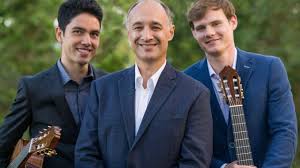
José Carbó Trio
José Carbó Trio

L’Heure Exquise

José Carbó Trio

Independent Theatre, North Sydney

11, March 2018

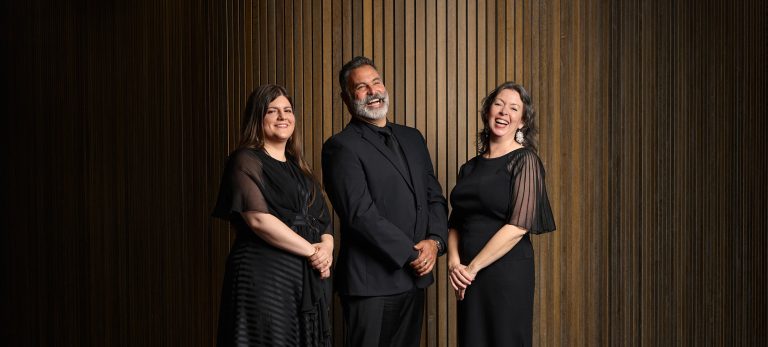
It was rare opportunity to hear the gilded voice of baritone José Carbó in an intimate recital of (mostly) art song accompanied on classical guitars by Andrew Blanch and Ariel Nurhadi. The three musicians make up the newly formed José Carbó trio and are undertaking a tour of NSW and Brisbane with the programme L’Heure Exquise (The Exquisite Hour) as well as recording it for release later this year.

A quote often attributed to Chopin comes to mind – “Nothing is more beautiful than a guitar, save perhaps two.” Add to these the voice of Carbó and you have a sound that is quite thrilling.

Singing in Italian, French, German and Spanish, the afternoon’s music comprised songs and instrumental numbers transcribed for baritone and two guitars. This required some deft navigating of keys and tuning, ultimately creating an innovative look at the new colours created by the two guitars in songs where we take for granted, the sound of the piano or the orchestra with the voice.

One of the secrets of art song is that the voice and its instrumental partner/s tell the tales in equal measure. The carefully selected repertoire was one that lent itself to the versatility of the classical guitar from the pressing terror of Schubert’s Erlkönig to the gently rocking Les Berceaux by Fauré, and even operatic repertoire.

Carbó and his colleagues opened the concert with Gluck’s Aria Antiche O del mio dolce ardor a simple rendition of a cornerstone classic that teaches and showcases technique. The two guitars ably took on the cascading suspensions of the introduction to Verdi’s concert aria Il poveretto, presaging the final item on the programme – more of that anon.

Anticipating the audience’s surprise at the decision to amplify both instruments and voice in this concert, Carbó  explained that it was a matter of delicately balancing the gentler sounds of the guitars against his voice, which at full power can compete with the sound of a jet engine! After some initial juggling, the amplification settled to being inconspicuous allowing the finer details of the guitar arrangements to be appreciated.

Manuel de Falla’s Spanish Dance No 1 from La Vida Breve was coupled with a gloriously rustic rendition of his traditional Siete Canciones populares Españolas.

However, it is in the field of classical singing and opera in particular, with which Carbó has nailed his colours to the mast. The brackets of art songs in French (Debussy’s Romance, Fauré’s Les Berceaux and Hahn’s L’Heure Exquise) and German (Schubert’s Der Neugierige and Erlkönig) pointed to that training – technical mastery of music and language, combined with the drama of storytelling – skill which he commented has taken 20 years to hone: “10 years to learn and 10 to refine.”

Interspersed with the vocal items, Blanch and Nurhadi presented a selection of pieces arranged for two guitars – Emilio Pujol’s arrangement of Granados’ Intermezzo from the opera Goyescas was a fiery and delightful reminder of the flamenco origins of the guitar; Peter Madlem’s Monte Carlo was dedicated to the classical guitar greats John Williams and Joe Pass, its relaxed syncopations ending on a crunchy suspended harmonic. Another guitar great, the late Philip Houghton was acknowledged with Lament a gently descending melody with a throbbing pedal point; and Alchemy.

The afternoon was peppered with personal anecdotes from the Argentinian-born Carbó about his singing career, graciously paying tribute to his mentors and teachers and how he came to be where he is today – a principal with Opera Australia and overseas, as well a recital and recording artist who will share the stage with Sumi Jo during her tour of Australia later this year.

For his final bracket, Carbó performed an ethereally beautiful and sublimely controlled rendition of L’Heure Exquise which contrasted with the dramatic and red-blooded Ideale by Tosti. Building to a thrilling climax, Carbó dispensed with amplification to demonstrate the awesome beauty of his voice in full Verdian operatic flight with Cortigiani vil razza dannata from Rigoletto.

Shamistha de Soysa for SoundsLikeSydney©
Similar Posts

  • Opera Review: La Traviata/ Opera Australia

    It’s everything you want opera to be. From its first trembling chromatics, the soloists dazzled, the chorus and orchestra were in fine form, Verdi’s music was impossible to resist and the tale oozed passion and tragedy. Add sumptuous and meticulously detailed costumes, sets and dramatic lighting and there you have the complete package. Opera Australia’s…

  • Album Review: Rhythms of Change/Edwardes/Move Records

    Album Rhythms of Change is a recent release by Australian percussionist Claire Edwardes on the Move label. Edwardes has made a towering contribution to raising the profile of percussion music in ensemble and in solo. This album was driven by her additional recognition of the need to address the lack of representation of women in…

  • Opera Review: Cavalleria Rusticana And Pagliacci / Opera Australia

    Cavalleria Rusticana – Pietro Mascagni; Pagliacci – Ruggero Leoncavallo  Opera Australia, Joan Sutherland Opera Theatre, Sydney Opera House, 12 January 2017  Opera Australia has continued its summer season with a new production of Cavalleria Rusticana and  Pagliacci, following its customary New Year performances of La Bohème. This double bill is a joint enterprise with the…

  • Opera Review: Il Viaggio A Reims/ Opera Australia

    Il Viaggio a Reims Opera Australia Joan Sutherland Theatre, Sydney Opera House, October 24th, 2019 Written by Victoria Watson The father of 19th century bel canto Gioachino Rossini wrote Il Viaggio a Reims specifically to coincide with and celebrate the 1825 coronation of the previously exiled King Charles X at Reims in rural France. The libretto…

  • Concert Review: Summer Winds- From Beethoven To Ravel/ Omega Ensemble/Sally Walker

    Summer Winds- from Beethoven to Ravel The Omega Ensemble – Sally Walker- flute/ David Rowden-clarinet/ Michael Dixon – French horn/  Ben Hoadley- bassoon/ Celia Craig -oboe 25 February, 2018 The Utzon Room, Sydney Opera House Written by Victoria Watson  The view of the harbour from the Utzon Room set the dramatic scene for this Sunday afternoon…

  • Concert Review: Splendour And Mystery/Sydney Chamber Choir

    Splendour and Mystery/ Sydney Chamber Choir
    Verbrugghen Hall, Sydney Conservatorium of Music
    Australian Digital Concert Hall
    25 March, 2023
    In Splendour and Mystery, Sydney Chamber Choir under the direction of Sam Allchurch joined forces with Camerata Antica led by Matthew Manchester and organist Thomas Wilson in an adventurous anthology of music written for double choir. Specialising in the music of the 16th and 17th centuries, the founder of Camerata Antica, Matthew Manchester playing the fiendishly difficult cornetto, was joined by Michael Wyborn, William Kinmont and Paolo Franks playing the equally challenging alto, tenor and bass sackbutts respectively.
    Bookended with pieces by Giovanni Gabrieli with one of his refreshing Canzonas in the middle, the program also contained music by living Australasian composers Clare Maclean and Brooke Shelley, Gabrieli’s contemporary and student Heinrich Schütz and 20th century composers John Tavener and Frank Martin. Together these composers explore and exploit the potential of the double choir with its opportunities for super-rich harmonies, added melodic lines, imitation, choral interplay and variations in the positioning of the singers.
    The opening motet, Gabrieli’s Jubilate Deo omnis terra, C 65 was quite literally a musical shout for joy. A major part of this journey back in time to Renaissance Venice was the unique sound of Camerata Antica. Heralded by the instruments, the 10 lines of the choir sang an uplifting, lively and tightly dotted chorus, alternating with homophonic passages. Allchurch and his ensemble clearly delineated the rhythms, changing time signatures, hemiolas and other displaced accents which created the buoyancy of this celebratory piece.
    John Tavener’s brilliant A Hymn to the Mother of God transcends the mortal and looks to the cosmic powers of Mother Mary. Writing in the style of canon, with imitative lines that start in quick succession and not necessarily in harmony, Tavener creates a sense of ‘other-worldliness’ in this simple but awe-inducing piece in three-sections. It was a slow burn as the two choirs sang with shimmering lightness and a sense of spinning through space, creating vivid colours and  clusters of clashing chords with impressive control as the voices rose in range and dynamic to its full-bodied climax.
    The program moved imperceptibly to the German Magnificat by Heinrich Schütz, as the choirs were joined by organ and instruments. This was a relevant and important inclusion as Gabrieli himself taught Schütz in this multi-choral technique which Schütz then developed in his own style.
    Clare Maclean’s moving Christ the King was sublimely sung, opening in the manner of a plainchant by the female voices which peeled off into mirroring phrases by the other voices, ending in a reprise of the plainchant. Premiered by this choir in 1984, it is precisely opportunities like these which new composers need for their music to be heard and re-heard until it becomes recognizable to listeners and enters the DNA of the concert repertoire.
    The short and brilliant burst of Gabrieli’s Canzona seconda, C 187  from Camerata Antica showcased these rudimentary instruments in all their imperfect glory as the choir positioned itself for Frank’s only unaccompanied choral work, the demanding  Mass for double choir, considered to be one of the finest and most complex pieces of 20th century choral music. The choir did ample justice to this piece which incorporates the aesthetics of Renaissance music, French Impressionism, Schoenberg’s twelve-note system and J S Bach. The altos began the Kyrie with a freely-flowing, supplicating melody; the Gloria built step-wise to cluster chords; the Credo was a business-like affirmation of faith; the canon-styled Et Resurrexit was levity, hope and word-painting to perfection; the Sanctus introduced softer harmonies from the male voices. The mass, Version 1, ended with a powerful Benedictus. Fast forward to 1926 and Martin added the Agnus Dei, the crowning glory to this choral magnum opus. The mass culminated in a glorious unification of the choirs.
    Brooke Shelley’s Heavenly Father, composed in 2022, performed in the presence of the composer was premiered in November 2022, by the Sydney Chamber Choir. A lyrical and beautifully textured piece, it is very pleasing that it has quickly been programmed again. Like the slightly older piece by Maclean, it is critical that new pieces of merit such as these, are given regular and frequent hearings so that they may be heard widely and face the test of time.
    Finally, Gabrieli’s Magnificat a 14, C 79 brought together the full instrumental and vocal forces of the ensemble. Using the 16th century Venetian technique of cori spezzati (split choirs), the brighter sound of the female voices and cornetto took to the left gallery with the male voices and the thrilling grunt of the bass and other sackbutts in the right gallery with a mixed ensemble placed and organ placed centrally on stage.
    This was an intelligent and audacious program from Allchurch, performed with glorious sound by a choir secure in technique, pitch and musicianship.

Leave a Reply

Your email address will not be published. Required fields are marked *