CD Preview: The Kiss/ Nicole Car/ Australian Opera And Ballet Orchestra/ Andrea Molino

download

Hot on the heels of her successful debut at the Royal Opera, Covent Garden, late in 2015 and several lauded roles for Opera Australia over the past few years, soprano Nicole Car has released her debut album The Kiss (ABC Classics).

For the recording, Andrea Molino conducts the Australian Opera and Ballet Orchestra, an ensemble with whom Nicole Car would be well accustomed to performing. The disc contains 14 tracks,(3 orchestral), with two additional tracks available digitally.

Nicole Car has had a meteoric rise, performing a spectrum of roles from her early portrayals of Léïla in The Pearlfishers and Micaëla in Carmen, to more recently, Tatyana in Eugene Onegin in Australia and London and The Countess in The Marriage of Figaro in Australia and Dallas. Some of the arias on The Kiss are ones she reprises from her recent notable roles; others are new to her performing repertoire. They are drawn from the repertoire at which she excels – the lyrical and dramatic arias of the 19th century which showcase her versatility from the heady delight of Marguerite’s Jewel Song from Gounod’s Faust, to the tentative  Micaëla in Carmen.

The Kiss is a testament to Nicole Car. It is a challenge to make operatic arias as moving on disc as they are on stage, sans dramatic context and visual adjuncts of acting, sets and costumes. But it is a challenge that Nicole meets convincingly. She sings her way through the stamina defying arias of grand opera in French, Italian, Russian and Czech with her characteristic purity of tone, surety and shimmer.

The CD gets off to a glittering start with Marguerite’s Jewel Song (Ah! je ris de me voir si belle en ce miroir), one of Nicole’s more recent stage roles. Her coloratura is unerringly accurate and evenly polished; she effectively conveys Marguerite’s excitement at the dazzling jewellery she has come upon and how fabulous they make her look.

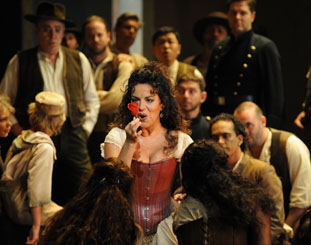
Mimi in La bohème and Micaëla in Carmen are two other roles that Nicole has portrayed on stage in recent years, with great success, so it is pleasing to hear her sing the signature arias of these two characters,  Mi chiamano Mimi (They call me Mimi) and Je dis que rien ne m’epouvante ( I say that nothing can frighten me).

Perhaps most endearing to hear, is the aria from Tatyana’s Letter Scene,  Puskai pogibnu ya (Even though it kill me) from Tchaikovsky’s Eugene Onegin, a role she made her own, both in Australia and in London, where The Guardian described her Tatyana as “among the best ever.” There is great interest in hearing Nicole sing Verdi (Tacea la notte placida from Il Trovatore and Come in quest’ora bruna (In this moment before dawn) from Simon Boccanegra in anticipation of her stage debut as Luisa Miller in Sydney later this year.

Car imbues Dvořák’s Song to the Moon (Měsíčku na nebi hlubokém) from Rusalka with a spectral and poignant beauty which she takes to a thrilling climax; arias from operas by Cilea, Io son l’umile ancella ( I am the humble servant) from Adriana Lecouvrier and Massenet, Ah!je suis seule, seule enfin….Dis-moi que je suis belle (Ah! I am alone, alone at last….Tell me that I am beautiful) from Thaïs, complete a sophisticated anthology.

Digital purchasers can also download the Polonaise from Act III of Eugene Onegin and Natalya’s aria  Pochudilis mne budto golosa (I thought I heard voices)  from another Tchaikovsky opera, Oprichnik (The Guardsman).

It is a great delight to hear the gifted musicians of the Australian Opera and Ballet Orchestra in their selection of orchestral excerpts.

The CD booklet contains the text of the arias in their original language along with English translations, synopses and historical notes, biographical notes and images. The recording was made in the Eugene Goossens Hall of the ABC Centre in Ultimo, Sydney during September 2015.

Shamistha de Soysa for SoundsLikeSydney©

The Kiss is available from February 6, 2016.


Similar Posts

  • Opera Australia 2015: “New Frontiers And Broad Appeal”

    Opera Australia today launches its 2015 Sydney season with a core of classics performed by a  stable of overseas and home-grown masters of their roles and creatives. The programme, it says is “uniquely audience-focused”, “highly accessible” and has the aim of further increasing audience numbers. Speaking to SoundsLikeSydney, Opera Australia’s  Artistic Director Lyndon Terracini affirms…

  • Concert Review: Splendour And Mystery/Sydney Chamber Choir

    Splendour and Mystery/ Sydney Chamber Choir
    Verbrugghen Hall, Sydney Conservatorium of Music
    Australian Digital Concert Hall
    25 March, 2023
    In Splendour and Mystery, Sydney Chamber Choir under the direction of Sam Allchurch joined forces with Camerata Antica led by Matthew Manchester and organist Thomas Wilson in an adventurous anthology of music written for double choir. Specialising in the music of the 16th and 17th centuries, the founder of Camerata Antica, Matthew Manchester playing the fiendishly difficult cornetto, was joined by Michael Wyborn, William Kinmont and Paolo Franks playing the equally challenging alto, tenor and bass sackbutts respectively.
    Bookended with pieces by Giovanni Gabrieli with one of his refreshing Canzonas in the middle, the program also contained music by living Australasian composers Clare Maclean and Brooke Shelley, Gabrieli’s contemporary and student Heinrich Schütz and 20th century composers John Tavener and Frank Martin. Together these composers explore and exploit the potential of the double choir with its opportunities for super-rich harmonies, added melodic lines, imitation, choral interplay and variations in the positioning of the singers.
    The opening motet, Gabrieli’s Jubilate Deo omnis terra, C 65 was quite literally a musical shout for joy. A major part of this journey back in time to Renaissance Venice was the unique sound of Camerata Antica. Heralded by the instruments, the 10 lines of the choir sang an uplifting, lively and tightly dotted chorus, alternating with homophonic passages. Allchurch and his ensemble clearly delineated the rhythms, changing time signatures, hemiolas and other displaced accents which created the buoyancy of this celebratory piece.
    John Tavener’s brilliant A Hymn to the Mother of God transcends the mortal and looks to the cosmic powers of Mother Mary. Writing in the style of canon, with imitative lines that start in quick succession and not necessarily in harmony, Tavener creates a sense of ‘other-worldliness’ in this simple but awe-inducing piece in three-sections. It was a slow burn as the two choirs sang with shimmering lightness and a sense of spinning through space, creating vivid colours and  clusters of clashing chords with impressive control as the voices rose in range and dynamic to its full-bodied climax.
    The program moved imperceptibly to the German Magnificat by Heinrich Schütz, as the choirs were joined by organ and instruments. This was a relevant and important inclusion as Gabrieli himself taught Schütz in this multi-choral technique which Schütz then developed in his own style.
    Clare Maclean’s moving Christ the King was sublimely sung, opening in the manner of a plainchant by the female voices which peeled off into mirroring phrases by the other voices, ending in a reprise of the plainchant. Premiered by this choir in 1984, it is precisely opportunities like these which new composers need for their music to be heard and re-heard until it becomes recognizable to listeners and enters the DNA of the concert repertoire.
    The short and brilliant burst of Gabrieli’s Canzona seconda, C 187  from Camerata Antica showcased these rudimentary instruments in all their imperfect glory as the choir positioned itself for Frank’s only unaccompanied choral work, the demanding  Mass for double choir, considered to be one of the finest and most complex pieces of 20th century choral music. The choir did ample justice to this piece which incorporates the aesthetics of Renaissance music, French Impressionism, Schoenberg’s twelve-note system and J S Bach. The altos began the Kyrie with a freely-flowing, supplicating melody; the Gloria built step-wise to cluster chords; the Credo was a business-like affirmation of faith; the canon-styled Et Resurrexit was levity, hope and word-painting to perfection; the Sanctus introduced softer harmonies from the male voices. The mass, Version 1, ended with a powerful Benedictus. Fast forward to 1926 and Martin added the Agnus Dei, the crowning glory to this choral magnum opus. The mass culminated in a glorious unification of the choirs.
    Brooke Shelley’s Heavenly Father, composed in 2022, performed in the presence of the composer was premiered in November 2022, by the Sydney Chamber Choir. A lyrical and beautifully textured piece, it is very pleasing that it has quickly been programmed again. Like the slightly older piece by Maclean, it is critical that new pieces of merit such as these, are given regular and frequent hearings so that they may be heard widely and face the test of time.
    Finally, Gabrieli’s Magnificat a 14, C 79 brought together the full instrumental and vocal forces of the ensemble. Using the 16th century Venetian technique of cori spezzati (split choirs), the brighter sound of the female voices and cornetto took to the left gallery with the male voices and the thrilling grunt of the bass and other sackbutts in the right gallery with a mixed ensemble placed and organ placed centrally on stage.
    This was an intelligent and audacious program from Allchurch, performed with glorious sound by a choir secure in technique, pitch and musicianship.

  • Concert Review: Chancellor’s Concert / Sydney Conservatorium Of Music Symphony Orchestra

    Chancellor’s Concert, Sydney Conservatorium of Music Symphony Orchestra, Verbrugghen Hall March 31 2017 Written by Ria Andriani The fourth in Sydney Conservatorium’s Chancellor’s Concert series, this outstanding performance brought an exciting program which Maestro Eduardo Diazmuñoz had designed as an homage to women in music as composers, performers and as muses. Aptly enough it was…

  • Bizet’s ‘Carmen’:Outstanding soloists in unflinching Andalusian style

     Carmen G Bizet, libretto by Henri Meilhac and Ludovic Halévy after Prosper Mérimée’s novel (1845). Opera Australia, Joan Sutherland Theatre, Sydney Opera House, February 3rd, 2014. According to operabase.com Bizet’s Carmen ( 1873 – 4) was the second most frequently performed opera, during the worldwide 2013-14 season, with 477 performances, coming second to La traviata (577 performances). Opera…

  • Nicole Car Debuts With The Australian Chamber Orchestra

    The Australian Chamber Orchestra’s April series marks the debut of soprano Nicole Car with the ensemble and is also the first concert at which ACO Principal Violin Satu Vänskä will play the magnificent 1726 Belgiorno Stradivarius violin, recently loaned to the ACO. In her only Australian orchestral appearance in 2018, Car and the ACO will perform a…

  • CD Review: Amy Dickson ‘Dusk & Dawn’

      Dusk & Dawn Amy Dickson,  Sony Classics 88725479572 Sydney born saxophonist Amy Dickson’s latest CD release Dusk & Dawn won for her the title of Breakthrough Artist of the Year at the 2013 Classical Brit Awards. This was the first Classical Brit Award for an Australian as well for the saxophone. Dusk & Dawn contains 12 familiar tracks arranged for saxophone and…

Leave a Reply

Your email address will not be published. Required fields are marked *